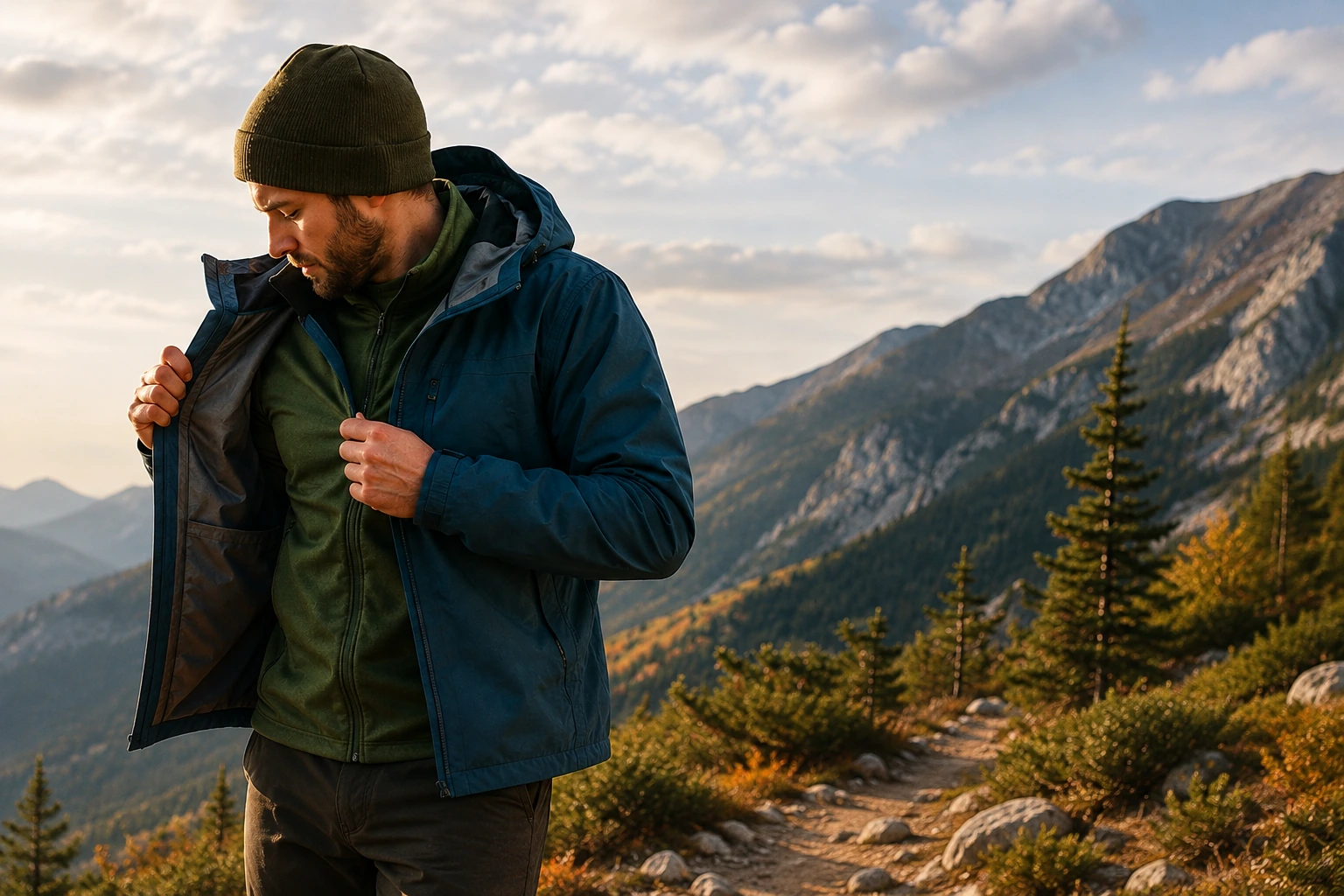
A layering system is useful because a hike rarely asks the same thing from your clothing for the entire day. You may start cool, warm quickly on a climb, step into wind on an exposed section, stop long enough to cool down, and return in a different temperature than the one you left in.
In this guide, “overheating” means becoming uncomfortably or excessively warm during ordinary hiking effort. It is not a medical diagnosis, and the goal is not to eliminate every drop of sweat.
The practical objective is simpler: use clothing as an adjustable system. Add, remove, open, close, or protect layers as your effort and the conditions change, while keeping enough reserve for the parts of the hike that may be colder, wetter, windier, or slower.
If you are still deciding what clothing and weather protection belong in your pack, start with What to Pack for a Day Hike in Changing Weather. This article focuses on what to do with those layers once you are using them.
SAFETY SCOPE
This guide covers general clothing and layering decisions for established, non-technical day hikes. It does not diagnose or treat heat illness, cold-related illness, dehydration, or other medical conditions. Follow current weather alerts, heat or cold guidance, closures, and instructions from the responsible local authority. If someone develops concerning symptoms or a medical emergency, stop relying on clothing adjustments alone and seek appropriate medical or emergency assistance.
Start With the Conditions and the Effort You Expect
Before choosing how much clothing to wear at the trailhead, look at two things together: the conditions you expect and the effort the route is likely to require.
A cool morning on a flat trail may call for a different starting combination than the same temperature before a sustained climb. A sunny valley can lead into a windy viewpoint. A short stop can feel very different from continuous uphill movement. Rain may matter less because of the number on the thermometer than because it combines with wind, a slower return, or a long exposed section.
Use the current forecast and alerts as inputs rather than guessing from the trailhead. What to Check in a Weather Forecast Before a Hike explains which forecast elements deserve attention before a day hike.
For layering, pay particular attention to:
- temperature changes during the hours you expect to be outside;
- wind on exposed sections; rain or wet snow when relevant;
- sun and heat exposure; the amount of climbing, descending, and stop-and-go travel;
- how long you may be stationary during breaks, viewpoints, delays, or route decisions;
- whether the return may happen in cooler or less sheltered conditions.
The same forecast can produce different clothing decisions for different routes and groups. The point is not to predict one perfect outfit. It is to begin with enough information to make useful adjustments later.
Think in Layer Functions, Not a Fixed Outfit
A three-layer system is a useful teaching model, but it should not be treated as a rule requiring exactly three garments on every hike. A better way to think about layering is through three functions: what you hike in, what adds warmth, and what protects you from weather.
The Layer You Hike In
This is the clothing doing most of the work while you are moving. It should fit the expected conditions and allow you to regulate heat as your effort changes.
In cool conditions, this layer may also need to handle moisture well enough that ordinary exertion does not leave you relying on damp clothing during a later stop. In hot conditions, official guidance commonly emphasizes loose, lightweight, light-colored clothing rather than a cold-weather layering recipe.
Material guidance changes with climate and use case. Cold and wet guidance often emphasizes clothing that manages moisture and retains useful warmth, while hot-weather guidance emphasizes loose, lightweight, breathable clothing. For this broad U.S.–Canada tutorial, function and context matter more than a universal fabric rule.
The Insulating Layer
Insulation is the layer you add when your active clothing is no longer enough to keep you comfortable at the effort level and conditions you are in.
You may need it before a long stop, during a slower section, on a cooler return, or when wind and temperature combine to reduce the margin you had while moving hard.
The useful question is not whether the insulating layer is part of a textbook three-layer system. It is whether you have enough warmth available for the credible colder parts of the outing without wearing unnecessary insulation during hard effort.
The Weather-Protection Layer
A weather-protection layer helps reduce exposure to wind, rain, or wet snow when those conditions are relevant. Depending on the garment, it may also provide useful adjustment features such as front zippers, underarm vents, adjustable cuffs, or other openings.
Weather protection should remain available even when you are not wearing it. A shell carried in the pack can be more useful than a shell worn continuously during a climb that leaves the clothing underneath unnecessarily wet.
At the same time, a shell does not make severe weather or dangerous exposure acceptable. It is one part of the system, not permission to continue regardless of conditions.
Adjust Before You Become Too Warm or Too Cold
Layering works best as a series of small decisions rather than one large correction after you are already uncomfortable.
In cool or cold conditions, official guidance from U.S. and Canadian authorities specifically advises removing layers as you warm and, in some cases, doing so before you begin sweating heavily. That does not mean sweating can always be avoided. It means that waiting until your clothing is already damp can reduce your options later.
The opposite is also true. If you are moving into a long stop, a cooler section, or stronger wind, waiting until you are already chilled may make the adjustment harder than adding insulation or weather protection a little earlier.
Use observable changes rather than a universal number: your effort is increasing, the wind is picking up, you are about to stop, the sun has disappeared, rain is starting, or the route is entering a more exposed section.
ADJUST EARLY, NOT AFTER THE SYSTEM FAILS
Layer management works best as a series of small, early adjustments. Vent, remove, add, or protect a layer while you still have options rather than waiting until you are heavily damp, chilled during a stop, or committed to an exposed section.
Use Ventilation as One of Your Adjustment Tools
Changing a layer does not always mean taking a garment completely off.
If your clothing allows it, opening a front zipper, underarm vent, cuff, pocket, or other ventilation feature can release heat without stopping for a full clothing change. That can be useful during a short climb, a brief warm spell, or a transition where you expect conditions to change again soon.
Ventilation is an option, not a required first step. If you are clearly wearing too much insulation for the effort, removing a layer may be the simpler response. If rain or wind is the main problem, closing the system may matter more than increasing airflow.
The useful habit is to notice that your clothing has more than two states—fully on and fully off—and to use the adjustments that actually fit the moment.
Change Layers When Your Effort Changes
Weather is only half of the layering problem. Your own heat production changes when the route changes.
Before and During a Climb
A sustained climb can make a comfortable trailhead outfit feel excessive within minutes. If the route ahead is clearly steeper, consider opening vents or removing unnecessary insulation before you are fully committed to the climb.
During the climb, reassess instead of assuming the first adjustment was enough. If you are becoming progressively warmer and damper, the system is telling you that your clothing and effort no longer match.
In hot conditions, clothing adjustment is only one part of the response. Current heat guidance also emphasizes pacing, shade, hydration, and reducing strenuous activity when conditions require it.
On Exposed or Windy Terrain
When you leave sheltered terrain, the same clothing can feel very different. Wind can increase heat loss and make a damp layer more consequential, while a ridge or viewpoint may provide fewer opportunities to stop and adjust comfortably.
Close unnecessary vents, add wind or weather protection, and add insulation if the conditions and effort justify it. Make the change while you still have a sheltered or straightforward place to do it when possible.
Do not treat an extra layer as a solution to exposure that has become unsuitable. If the route, weather, or official guidance no longer fits the plan, the correct adjustment may be the hike itself.
During Stops, Slow Sections, and the Return
The clothing that works while climbing may not be enough when you stop moving. A viewpoint break, navigation pause, slower group member, minor delay, or long descent can reduce the heat you are producing.
Add insulation or close the system before a longer stop if the conditions justify it. When you start moving hard again, reassess rather than automatically keeping every added layer on.
The return deserves its own check. Temperature, wind, sun exposure, and energy level may all be different several hours after departure, even on the same trail.
Manage Moisture, Not Just Warmth
A useful layering system manages moisture as well as temperature.
In cool or cold conditions, wet clothing can increase heat loss and reduce the usefulness of insulation. That is why official winter guidance often emphasizes adjusting layers before heavy sweating and changing into dry clothing when you become wet.
For a day hike, the practical response is to avoid creating more moisture than necessary when simple adjustments are available, and to protect reserve insulation from rain or pack moisture.
Do not turn this into the impossible goal of staying completely dry. Hard effort, humidity, rain, and individual physiology can all produce moisture. The goal is to preserve enough clothing function and flexibility for the rest of the route.
This is also why material advice should stay contextual. Instead of treating one fabric as universally good or bad, ask what the garment needs to do in the conditions you are actually facing: move moisture, retain warmth, block wind, shed rain, or remain comfortable in heat.
Adapt the System for Rain, Wind, Sun, and Rapid Changes
Different conditions call for different adjustments:
- Rain: add appropriate weather protection and keep reserve insulation dry. If rain combines with flooding, dangerous crossings, severe weather, or closures, the issue is no longer just clothing.
- Wind: reduce unnecessary ventilation and add wind protection or insulation as needed, especially on exposed terrain.
- Sun and heat: remove unnecessary insulation, use a lighter and looser clothing setup appropriate to current conditions, and follow current heat guidance for pacing, shade, hydration, and activity limits.
- Rapid temperature change: keep insulation and weather protection accessible so you can respond without unpacking the entire backpack.
- Mixed conditions: avoid locking yourself into one outfit. A hike that alternates between sun, cloud, wind, rain, climbs, and stops is exactly where small repeated adjustments are most useful.
These clothing decisions should support the larger plan rather than replace it. How to Prepare for a Day Hike When the Weather Can Change Quickly explains how route timing, exposure, and a practical Plan B fit together before departure.
Know When Layering Is Not the Answer
Some discomfort can be solved by opening a zipper, removing insulation, adding a shell, or putting on a warmer layer. Other problems require a different decision.
LAYERS DO NOT OVERRIDE THE PLAN
A better clothing adjustment can improve comfort and margin during ordinary changes in effort and weather. It does not make severe weather, dangerous exposure, closures, or concerning medical symptoms acceptable. When the problem is larger than the clothing system, change the plan and follow current official guidance.
Concerning Heat or Cold Symptoms
Feeling warm during a climb is a normal layering problem. Feeling faint, weak, confused, or otherwise medically unwell is not.
Current U.S. heat guidance directs people who feel faint or weak during exertion in heat to stop activity and get to a cool place, and it advises seeking medical care for symptoms of heat-related illness. Canadian cold-weather guidance similarly treats confusion, slurred speech, stiff muscles, or uncontrollable shivering as reasons to seek medical assistance.
This tutorial does not teach diagnosis or treatment. If symptoms become concerning, stop relying on routine clothing adjustments and follow the appropriate medical or emergency guidance for the situation.
Severe Weather or Unsafe Exposure
A better layering system cannot make every route appropriate.
If severe weather, dangerous wind exposure, flooding, closures, or another official warning changes the basis of the plan, adding clothing is not the primary solution.
If the decision has shifted from clothing management to whether the group should continue, use When Should You Turn Back During a Hike? for the on-trail decision framework.
A Clothing System That Is Already Wet or Inadequate
Sometimes the available layers simply do not match the conditions anymore. Your insulation may already be wet, your weather protection may be inadequate, or the temperature and exposure may have moved beyond the margin you planned for.
Do not treat repeated adjustments as proof that the system is still sufficient. If you no longer have a workable clothing setup for the route ahead, use the simpler option while you still have one: shorten the hike, use the planned alternative, or turn back according to current conditions and official guidance.
Use a Simple Layering Decision Table
The table below is an MCD Outdoor decision aid, not an official safety formula. It shows how ordinary clothing adjustments differ from situations where the route, activity, or medical response needs to change.
| What Is Changing | Likely Clothing Response | When Clothing Adjustment Is Not Enough |
|---|---|---|
| You are warming quickly during a climb | Vent or remove unnecessary insulation; reassess as the climb continues | Heat conditions or concerning symptoms require reducing or stopping activity |
| Wind increases on exposed terrain | Close vents; add wind/weather protection and insulation if needed | Exposure becomes unsuitable or current official guidance requires a plan change |
| You stop or slow down | Add insulation or close the system before cooling becomes pronounced | Available clothing is inadequate for the conditions or expected delay |
| Rain begins | Add appropriate weather protection; protect reserve insulation from moisture | Severe weather, flooding, dangerous crossings, or closures affect the route |
| Sun and heat increase | Remove unnecessary insulation; use a lighter, looser clothing setup appropriate to the conditions | Current heat guidance or concerning symptoms indicate activity should be reduced or stopped |
| Temperature drops later in the hike | Add insulation or weather protection as needed | Conditions exceed the group’s clothing system, experience, or remaining margin |
The final column is the boundary to protect. Clothing can improve comfort and ordinary weather margin. It cannot turn an unsuitable route, serious health concern, or official restriction into a layering problem.
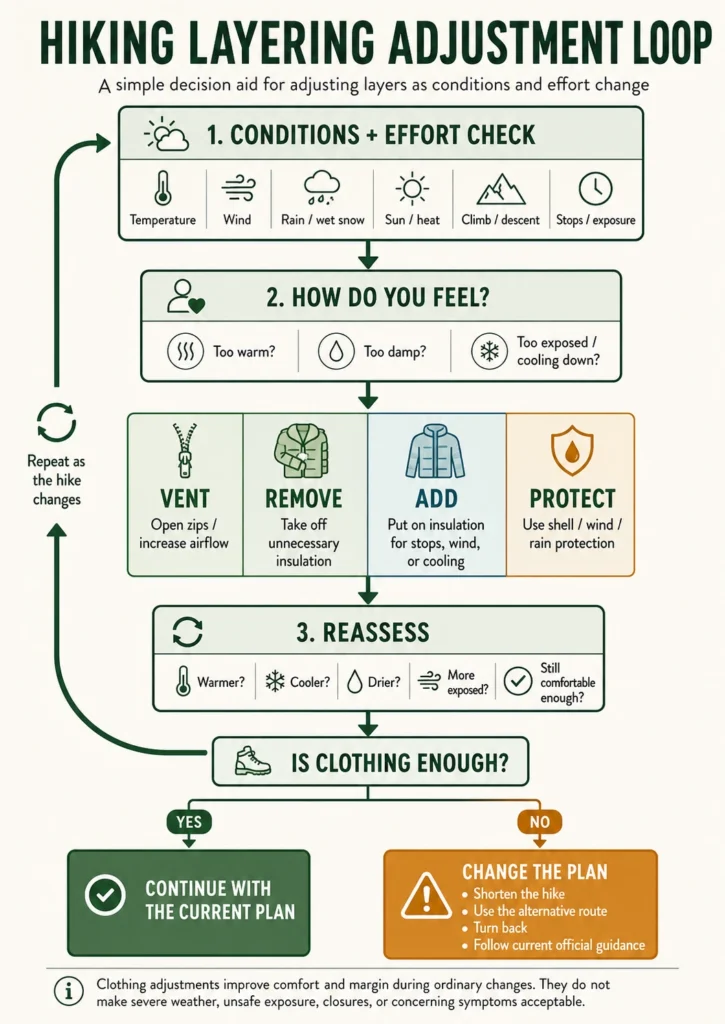
Do a Quick Layer Check
Use this as a brief self-check whenever the route, effort, or weather changes. It is not a timed safety test.
Ask:
- Am I getting progressively warmer or colder at this effort level?
- Am I creating more moisture than the conditions and clothing system can reasonably manage?
- Has the wind, rain, sun, or temperature changed enough to justify a clothing adjustment?
- Am I about to climb, stop, descend, or enter a more exposed section?
- Do I still have dry insulation or weather protection available if conditions worsen?
- Is this still a clothing problem, or has the route, weather, or a health concern become the real issue?
If the answer points to a simple adjustment, make it while you still have options. If it points to a larger problem, change the plan rather than asking the clothing system to do more than it can.
Key Takeaways
- Treat layering as an adjustable system, not one outfit chosen at the trailhead.
- Think in three functions: what you hike in, what adds warmth, and what protects you from weather.
- Adjust clothing when effort changes, not only when the forecast changes.
- Use ventilation when it helps, but do not treat it as a mandatory step before removing a layer.
- In cool or cold conditions, early adjustments can reduce unnecessary moisture buildup and preserve clothing function for later stops or exposure.
- Hot-weather clothing guidance is different from cold-weather layering guidance; avoid universal fabric rules.
- Keep insulation and weather protection accessible for stops, wind, rain, and cooler returns instead of wearing everything continuously.
- Recognize the boundary between a clothing problem and a plan or health problem. Severe weather, unsafe exposure, official restrictions, or concerning symptoms require more than another layer change.
Explore the full Weather-Ready Day Hiking guide series.
Sources and Further Reading
- Parks Canada — Hiking Tips — Rouge National Urban Park
- Parks Canada — How to Prepare for a HikeNational Park Service — Safety — Harpers Ferry National Historical Park
- National Park Service — Be Winter Ready For Your Adventure
- National Weather Service — Outdoor Activities: Heat Safety and Preparedness
- Centers for Disease Control and Prevention — Heat and Athletes
- Environment and Climate Change Canada — Be Prepared for Winter Weather