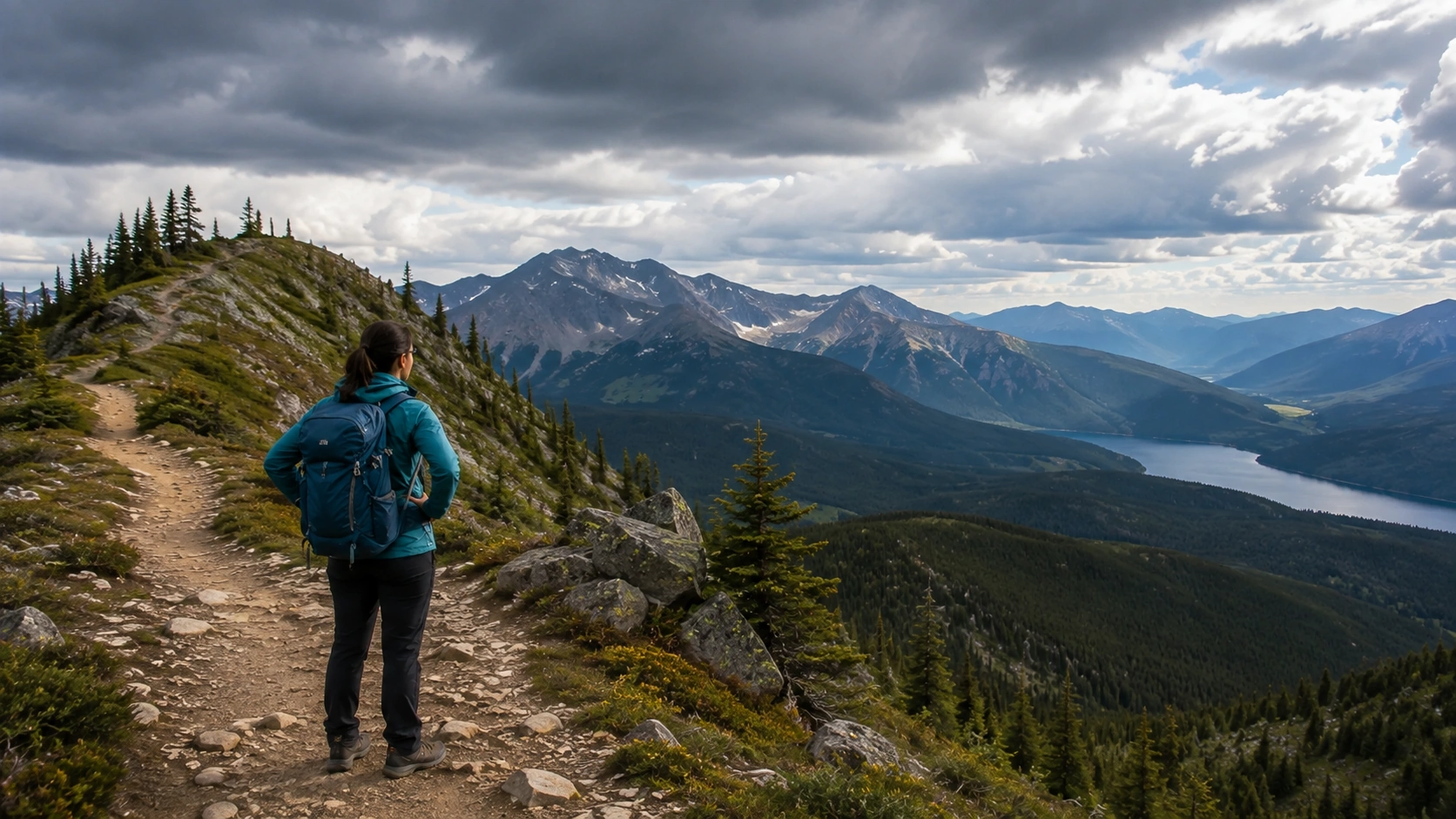
Turning back is not a failed hike. It is one of the outcomes a prepared hiking plan must preserve.
The purpose of a turnaround decision is not to prove that the route has become impossible. It is to act while the return remains familiar, daylight and energy remain, and the group still has useful options. Waiting until every problem becomes severe can turn a manageable retreat into an urgent situation.
Safety Scope
This guide supports decision-making on established, non-technical day-hiking trails. It does not declare a route safe, replace current alerts or closures, provide medical advice, or replace instructions from the responsible local authority.
For the complete weather-ready planning process—including route definition, forecast review, Plan B, and turnaround criteria—see How to Prepare for a Day Hike When the Weather Can Change Quickly.
Turn Back Before the Decision Becomes Urgent
The best time to turn back is usually before the group feels trapped into doing so.
A practical turnaround decision preserves several things at once:
- a familiar and usable return route;
- enough daylight to complete the return;
- sufficient energy, food, water, and clothing;
- working navigation and communication options;
- the ability to respond if another problem develops.
Do not wait for every factor to become severe. A route can still be physically passable while no longer fitting the available time, weather, equipment, or group.
The National Park Service recommends tracking total hiking time, remembering that the return is part of the trip, setting a turnaround time when progress is slower than expected, and following that decision.
Decision Point
Turn around while the route back is still familiar, daylight remains, and the group still has enough capacity to retreat.
Separate Hard Stops From Warning Signs
For this guide, a hard stop is a condition that ends the original plan. A warning sign is evidence that the plan may be losing its safety margin.
Hard stops
The original objective should end when:
- an official closure, evacuation order, or responsible authority requires it;
- thunder is heard or a lightning threat requires immediate movement toward proper shelter;
- a crossing, slope, trail section, or other obstacle no longer matches the group’s skills or equipment;
- a participant requires urgent assistance or cannot continue reliably;
- the group can no longer confirm its position or intended route;
- essential navigation, lighting, communication, or protective equipment is unavailable;
- continuing would depend on ignoring a known restriction or hazard.
A hard stop does not always mean retracing every step. Follow current instructions and choose the most appropriate practical option for the current conditions.
Warning signs
Warning signs include:
- starting later than planned;
- moving substantially slower than expected;
- losing the planned daylight buffer;
- worsening visibility;
- increasing wind or precipitation;
- wet clothing or inadequate temperature protection;
- declining group energy or concentration;
- uncertainty about the route ahead;
- an alternative or retreat route becoming harder to use.
One warning sign may justify an adjustment. Several warning signs together may justify ending the hike.
Weather and Official Information
A forecast is only one part of the decision. Continue monitoring current alerts, closures, trail information, and conditions that can be observed from the route.
For a detailed breakdown of the forecast elements to review before departure, see What to Check in a Weather Forecast Before a Hike.
The National Park Service advises hikers to check the weather and park alerts, avoid taking unnecessary chances when conditions are not suitable, and keep a Plan B available. Parks Canada similarly recommends checking the weather forecast, current trail conditions, and the route map before departure.
Reassess the plan when:
- an alert, warning, closure, or local instruction changes;
- precipitation begins earlier or becomes heavier than expected;
- visibility deteriorates;
- exposed terrain becomes incompatible with wind or storms;
- temperature, wind, and wet clothing reduce the group’s margin;
- water levels, snow, ice, or mud alter the trail;
- observed conditions no longer resemble the assumptions used during planning.
Thunder and lightning
Do not treat thunder as a minor warning to watch from an exposed trail.
The National Weather Service states that there is no safe place outdoors when thunderstorms are in the area. If thunder is heard or the sky becomes threatening, move to an appropriate safe place immediately. A substantial building or hard-topped vehicle provides proper shelter; open shelters and small structures do not.
The correct response may involve leaving a ridge, summit, shoreline, open area, or other exposed terrain rather than simply continuing toward the original destination.
Daylight, Pace, and Turnaround Time
A turnaround time is a decision deadline. It is not a prediction of when the group should reach the destination.
Set it before departure using:
- the planned return time;
- the estimated travel time from the farthest point;
- the group’s realistic pace;
- terrain and elevation;
- stops and expected delays;
- an additional buffer for changing conditions.
During the hike, compare real progress with the plan. Do not continue using the original schedule after the assumptions behind it have changed.
Turn back when the planned turnaround time arrives, even when the destination appears close. Also consider turning back earlier when:
- the group is consistently behind schedule;
- the return includes slower or more difficult terrain;
- weather is reducing the expected pace;
- the group has used more energy or supplies than planned;
- the remaining daylight buffer is becoming too small.
The National Park Service specifically recommends setting and respecting a turnaround time so hikers do not become stuck outside after dark.
Beginner Note
A turnaround time is a decision deadline, not a prediction of when the group will reach the destination.
Trail Conditions and Route Exposure
Published trail difficulty describes a route under a limited set of assumptions. Actual difficulty changes with weather, surface conditions, visibility, water levels, snow, ice, and the condition of the group.
Turn back or change the objective when you encounter:
- a washed-out or closed trail section;
- a stream crossing that is faster, deeper, or less stable than expected;
- steep snow or ice without appropriate equipment and experience;
- unstable footing near cliffs, waterfalls, or exposed terrain;
- deep mud, flooding, or fallen trees that substantially change the route;
- visibility too poor for the required navigation;
- terrain that would become difficult to reverse later;
- exposure that no longer fits the wind, storm, or temperature conditions.
Do not improvise around a serious obstacle merely because the destination is nearby. An unofficial detour may introduce navigation problems, private property, unstable terrain, environmental damage, or a more difficult return.
National Park Service winter guidance recommends checking forecasts and trail conditions, knowing the route, not relying on other people’s tracks, and remaining willing to turn around as conditions change.
Group Condition and Individual Limits
The plan must continue to fit the entire group, not only the strongest or most motivated participant.
Reassess when someone is:
- moving progressively slower;
- struggling to remain warm, dry, or comfortable;
- experiencing pain or an injury that affects travel;
- repeatedly stumbling or having difficulty concentrating;
- becoming anxious about the terrain or conditions;
- running short of essential food, water, medication, or equipment;
- unable to maintain the pace required for the planned return.
The group should remain together. Do not pressure a participant to continue because others feel close to the destination.
The National Park Service recommends selecting a route that everyone can complete, keeping the group together, and allowing the slowest hiker to establish the pace.
When health concerns are involved, use appropriate professional guidance and the group’s emergency plan. This article does not determine whether a medical condition is safe.
When Several Small Problems Combine
A turnaround decision does not require one dramatic event.
Consider a group that:
- began forty minutes late;
- is moving more slowly than planned;
- has wet clothing;
- is encountering worsening visibility;
- has less remaining daylight than expected.
None of those problems may appear decisive by itself. Together, they reduce time, warmth, navigation margin, and the ability to respond to another delay.
Ask three questions:
- Is the group’s remaining margin increasing or shrinking?
- Will retreat become more difficult if the group continues?
- Does continuing depend on the weather, pace, or trail improving?
When the plan only works if several uncertain factors improve, it is no longer a strong plan.
Turnaround Decision Table
On mobile, swipe horizontally to compare all columns.
| Observed signal | Planning meaning | Default response |
|---|---|---|
| Official closure, evacuation, or restriction | The original plan is no longer permitted or appropriate | Stop the original plan and follow official instructions |
| Thunder or an approaching lightning threat | The group may be within striking distance | Leave exposed terrain and reach appropriate shelter immediately |
| Visibility is deteriorating | Navigation and terrain recognition are becoming less reliable | Turn back before the known route becomes difficult to follow |
| The daylight buffer is disappearing | The return may extend into darkness | Respect the turnaround time and begin the return |
| The group is slower than planned | The original timing assumptions are no longer valid | Shorten the objective or turn back |
| A crossing or trail section is worse than expected | The route no longer matches the planned conditions | Do not improvise; use an appropriate known alternative or turn back. |
| A participant cannot continue reliably | The group no longer has the capacity required by the plan | Stop, reassess, and begin the appropriate return or emergency response |
| The group cannot confirm its location | Navigation confidence has been lost | Stop moving, confirm the route, and follow the emergency plan if necessary |
| Essential equipment is unavailable or damaged | The group’s safety margin has been reduced | Simplify or end the plan rather than improvising around the missing essential |
The table provides a conservative planning framework. Current instructions from the responsible authority take priority.
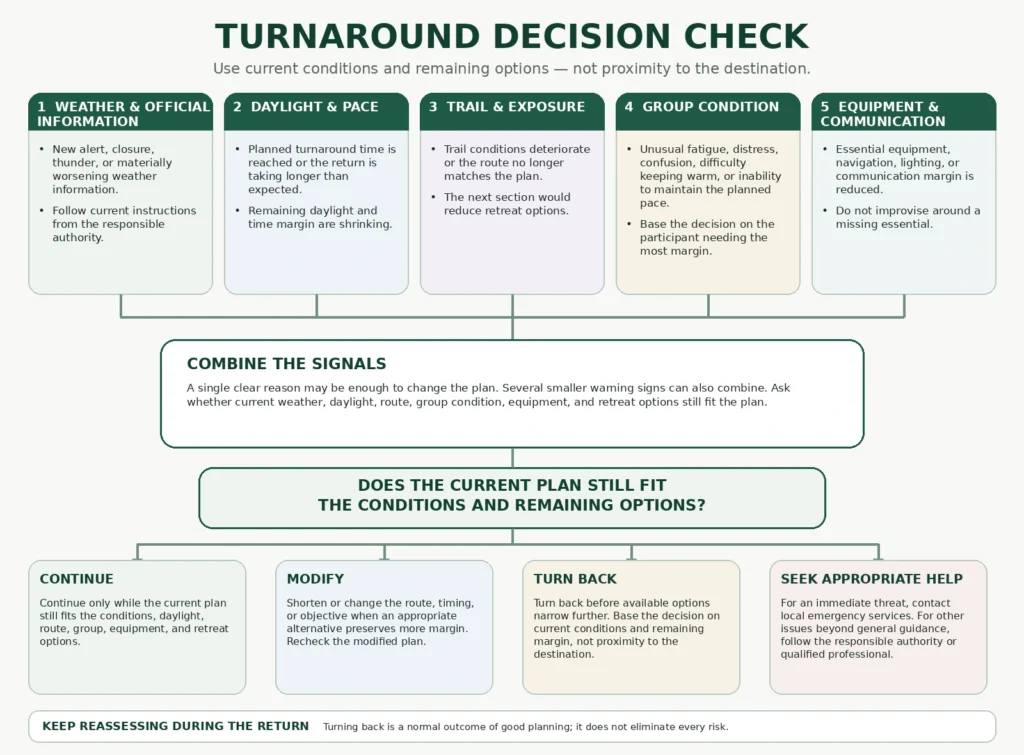
Select the diagram to view it at full size.
Use a Simple Turnaround Check
Before continuing into a more exposed, remote, or difficult part of the route, ask:
- Do current official information and observed trail conditions still support the plan?
- Can the entire group complete the return with the remaining daylight, energy, clothing, food, and water?
- Is the route ahead easier to leave now than it will be later?
- Do we still have the navigation, communication, lighting, and protective equipment required for the return?
- Are we continuing because the plan still fits, or because we are emotionally invested in reaching the destination?
A single clear “no” may be enough to change the plan. Several uncertain answers should be treated as a combined warning.
What to Do After You Turn Back
Once the decision is made, communicate it clearly.
Avoid language such as “maybe we should head back soon” when the group has already decided. State the new objective:
“We are ending the original plan and returning now.”
Then:
- keep the group together;
- use the most appropriate known return route for the current conditions and follow applicable official guidance;
- avoid unplanned shortcuts;
- continue monitoring weather and trail conditions;
- allow the slowest participant to set a sustainable pace;
- preserve food, water, lighting, and communication resources;
- update the person holding the trip plan when communication is available;
- follow current instructions from park, trail, weather, or emergency authorities.
Turning back does not eliminate every risk. Conditions can continue to change during the return, so keep reassessing until the group reaches the trailhead or another appropriate location identified by the return plan or current official guidance.
After the trip, record why the decision was made. That information can improve future route selection, start times, equipment choices, and turnaround criteria.
Emergency
If there is an immediate threat to life or safety, contact local emergency services and follow instructions from the responsible local authority.
Key Takeaways
- Turning back is a planned outcome, not a failed hike.
- Hard stops override the original objective.
- Several smaller warning signs can combine into one decisive reason.
- Use a turnaround time and preserve a daylight buffer.
- Base the decision on the whole group, not the strongest participant.
- Turn around while the return remains practical.
- Official alerts, closures, and emergency instructions take priority.
Explore the full Weather-Ready Day Hiking guide series.
Sources and Further Reading
- Hike Smart — U.S. National Park Service
- Winter Hiking Tips — U.S. National Park Service
- Lightning Safety Overview — National Weather Service
- How to Prepare for a Hike — Parks Canada
- Safety on Land — Bruce Peninsula National Park, Parks Canada
- Canadian Lightning Danger Map — Environment and Climate Change Canada