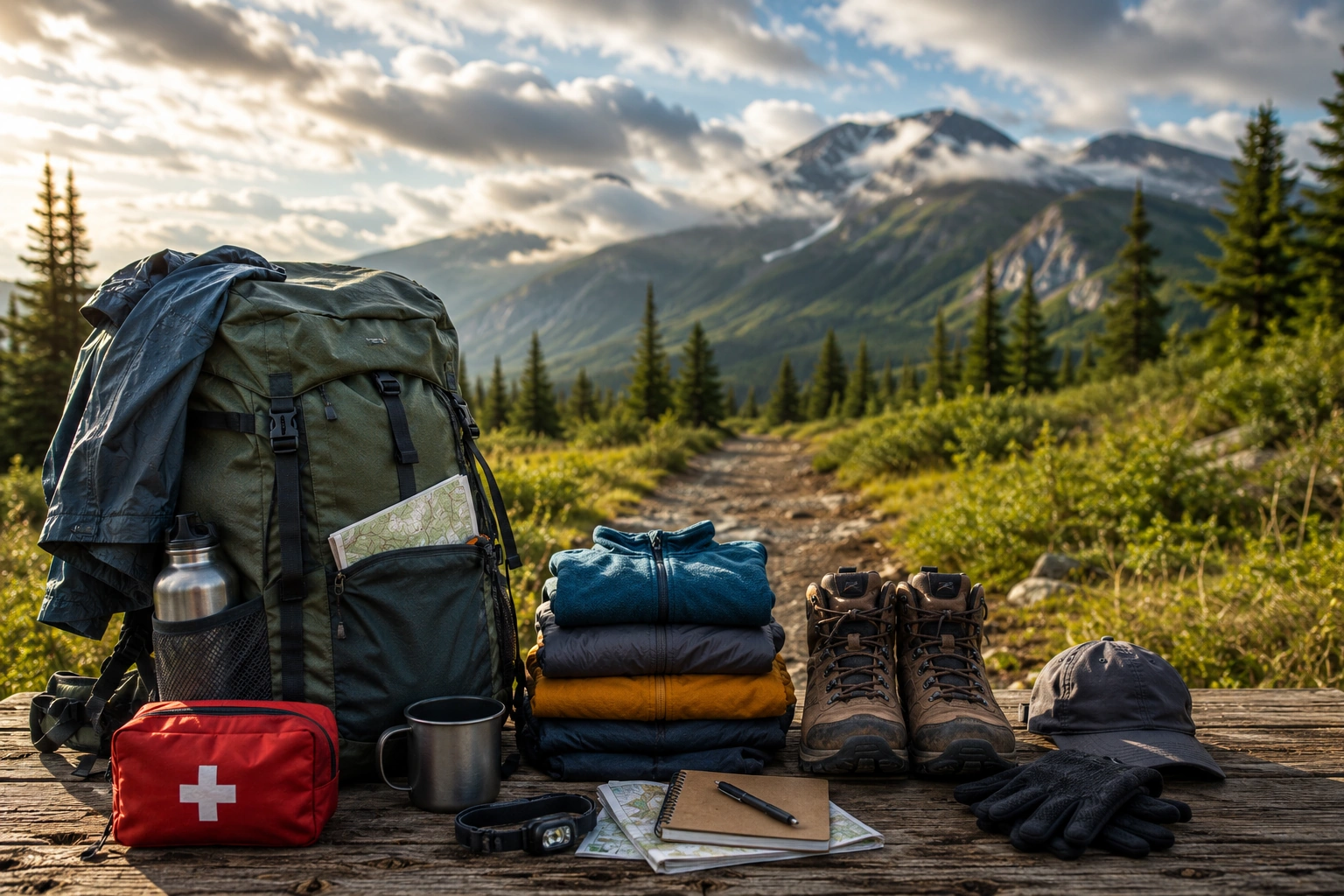
Packing for a day hike is easy when you imagine the conditions staying exactly as forecast. Real trails are less predictable.
Temperatures can fall as you gain elevation. Rain can arrive earlier than expected. Wind can make exposed sections feel very different from sheltered forest. A delay can keep you outside longer than planned. Smoke, storms, closures, or changing trail conditions can alter the plan altogether.
That does not mean carrying everything you own.
A useful day hike packing list starts with a reliable core and then adjusts for the specific route, forecast, timing, exposure, and consequences of changing conditions.
The goal is not to pack for every imaginable emergency. It is to prepare sensibly for the credible conditions your hike could actually present.
SAFETY SCOPE
This guide covers general preparation for established, non-technical day-hiking trails. Always follow current weather alerts, closures, restrictions, fire or air-quality guidance, and instructions from the responsible local authority. For medical concerns, emergencies, technical terrain, specialized activities, or equipment failures beyond routine use, seek the appropriate qualified professional, emergency service, guide, or manufacturer.
Start With the Route and Forecast, Not the Backpack
Before deciding what goes into your pack, understand the hike you are preparing for.
Consider:
- expected trip duration;
- elevation gain and exposed terrain;
- how quickly you can retreat or shorten the route;
- how far you will be from roads, facilities, or reliable communication;
- expected temperature changes during the day;
- precipitation and wind;
- thunderstorm potential;
- heat and sun exposure;
- smoke or current air-quality concerns;
- current trail conditions, warnings, and closures.
A mild forecast at the trailhead may have different consequences on a short forest loop than on a longer route with exposed ridges and limited opportunities to turn around.
Before finalizing your packing decisions, review What to Check in a Weather Forecast Before a Hike and look beyond the headline temperature.
PACK FOR CONSEQUENCES, NOT JUST CONDITIONS
A forecast tells you what may happen. Your route determines what those conditions could mean. Pack for the credible consequences of getting colder, wetter, delayed, or exposed—not simply for the temperature shown at the trailhead.
Once you understand those consequences, you can decide what deserves space in your backpack.
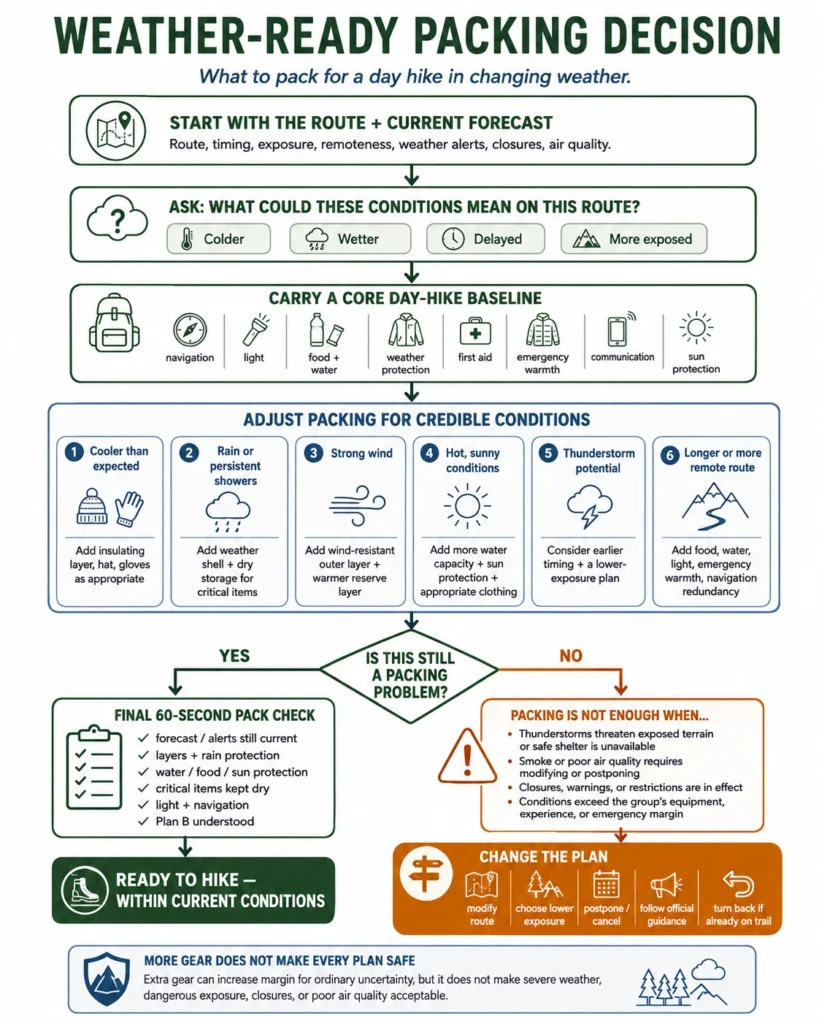
Carry a Core Day-Hike Baseline
Forecast-specific items should be added to a basic preparation system, not replace it.
For an established day hike, think in terms of functions rather than a rigid product checklist.
Your core system should address:
- Navigation: the information and tools needed to follow the route and recognize alternatives or turnaround points.
- Light: a dependable light source if the hike lasts longer than expected.
- Food and water: enough capacity for the planned outing with an appropriate margin for delays and conditions.
- Weather protection: clothing that can be adjusted when temperature, wind, or precipitation changes.
- First aid and personal needs: supplies appropriate to the group, including required personal medications.
- Emergency warmth or shelter: a way to preserve warmth and reduce exposure if progress stops unexpectedly.
- Communication: a charged phone or other communication option appropriate to the route, while recognizing that cellular coverage may be unreliable.
- Basic repair and utility needs: simple items appropriate to the equipment and problems reasonably expected on the trip.
- Sun protection: protection appropriate to expected sun exposure.
The exact contents will vary.
A short, popular trail close to services does not create the same consequences as a longer route where a wrong turn, injury, weather change, or delay could leave the group outside for hours.
A baseline gives you a starting point. It does not guarantee that every route or set of conditions is appropriate.
Build a Layering System for Changing Conditions
Changing weather is easier to manage when clothing can be adjusted as conditions and activity levels change.
Instead of relying on one heavy garment, think about three functions: what you hike in, what adds warmth, and what protects you from weather.
Start With the Layer You Will Hike In
Your active clothing should suit the expected temperature, effort, and conditions.
You may begin the hike feeling cool and become considerably warmer once you start climbing. Conversely, a comfortable shirt at a sunny trailhead may provide little margin once you stop moving in wind or cooler conditions.
Choose clothing that lets you regulate temperature during activity rather than forcing you to wear every layer from the beginning.
The objective is flexibility.
Add an Insulating Layer
An insulating layer provides additional warmth when activity slows, the temperature drops, wind increases, or the group has to stop unexpectedly.
How much insulation you need depends on the actual trip: season, elevation, forecast range, route exposure, duration, and individual needs all matter.
The question is not simply, “Will I be warm while walking?”
Ask what happens if you have to wait, move more slowly than expected, or remain outside later in the day.
Carry a Weather Shell
When rain or wind is a credible possibility, an appropriate outer shell can help protect the layers underneath and reduce exposure to the weather.
Its role is not to make severe conditions harmless.
It provides useful margin when ordinary weather changes occur within a hike that remains otherwise appropriate.
If conditions become severe enough that the route, terrain, or group is no longer suitable, changing the plan matters more than adding another layer.
Keep Critical Gear Dry
Rain can affect more than comfort.
Navigation information, insulating clothing, electronics, first-aid supplies, emergency items, and other critical equipment may become less useful if they are soaked.
Use protected storage appropriate to the expected conditions.
Depending on your system, that may mean a pack liner, protected internal bags or pouches, weather-resistant containers, or another method that helps keep important items functional.
Prioritize items whose failure would create a real problem:
- spare or insulating clothing;
- navigation information;
- phone and backup power;
- first-aid supplies;
- emergency warmth or shelter;
- matches, lighters, or other sensitive items when carried and permitted;
- important documents or instructions.
Do not assume that a backpack or storage system is completely waterproof unless the manufacturer specifically states that it is.
The practical goal is simpler: keep essential equipment usable when the weather turns wet.
Adjust Water, Food, and Sun Protection
There is no single water quantity that works for every hiker and every day hike.
A useful plan considers:
- trip duration;
- temperature and humidity;
- direct sun exposure;
- physical effort;
- individual and group needs;
- dependable opportunities to obtain additional water;
- the consequences of an unexpected delay.
Hotter or longer trips, exposed terrain, and routes without reliable resupply may justify carrying more capacity than a short outing in mild conditions.
Food should follow similar reasoning.
Bring enough for the planned hike while considering whether a delay could keep you outside substantially longer than expected. For longer or more remote routes, additional food can provide useful margin without turning the backpack into an expedition load.
Sun protection also changes with exposure. Consider clothing, head protection, sunglasses, and sunscreen as appropriate to the conditions and route.
Tree cover at the trailhead does not necessarily mean the entire hike will be shaded.
Match Extra Gear to Route Exposure and Remoteness
The farther you move from an easy exit, the more important the consequences of a delay become.
That may justify additional margin in areas such as:
- food and water;
- insulation;
- emergency warmth;
- lighting;
- navigation redundancy;
- backup power;
- communication appropriate to the route.
But remoteness is only one factor.
A relatively short hike can still deserve additional preparation if it involves exposed terrain, rapidly changing mountain weather, limited shelter, difficult route finding, or slow retreat.
Think in terms of consequence and time to recover.
If something changes, how quickly can you return to a safer or simpler situation?
This is also where your backup plan matters. How to Prepare for a Day Hike When the Weather Can Change Quickly explains how route alternatives, timing, and a practical Plan B can reduce dependence on equipment alone.
Extra gear is most useful when it supports a sound plan. It should not be used to justify a route whose conditions have become inappropriate.
Know When More Gear Is Not the Answer
Some problems are packing problems.
Others are decision problems.
Recognizing the difference is one of the most important parts of weather-ready hiking.
MORE GEAR DOES NOT MAKE EVERY PLAN SAFE
Extra clothing, food, water, or emergency gear can increase your margin for ordinary uncertainty. They do not make severe weather, dangerous exposure, closures, or other serious hazards acceptable.
Follow current official guidance and modify, postpone, or cancel the hike when conditions require it.
Thunderstorms and Exposed Terrain
A rain shell and warm layer may help with ordinary rain and cooling.
They do not solve lightning exposure.
The National Weather Service advises that there is no safe place outdoors when thunderstorms are in the area and emphasizes reaching appropriate shelter rather than relying on outdoor techniques or equipment.
If thunderstorms threaten an exposed route and appropriate shelter cannot be reached in time, the packing list is no longer the primary issue.
Change the timing, choose a lower-exposure alternative, postpone the hike, or follow the current instructions of the responsible weather and park authorities.
Smoke and Poor Air Quality
Wildfire smoke should also be treated primarily as a planning and health-guidance issue rather than an equipment problem.
Check current air-quality information and public-health guidance for the area before leaving and again when conditions are changing.
Depending on current official guidance and individual circumstances, the appropriate response may be to reduce activity, change the route or timing, reschedule, or cancel the outing.
Do not treat a respirator or other equipment as automatic permission to continue strenuous hiking in unhealthy smoke conditions.
People with medical concerns or symptoms should follow appropriate health guidance and consult a healthcare professional when necessary.
Closures, Warnings, and Restrictions
No packing list overrides a closure, evacuation order, fire restriction, official warning, or instruction from the authority responsible for the area.
If the route is closed, choose another route.
If an official warning changes the assumptions behind your plan, reassess the hike rather than searching for another item to put in the backpack.
The same principle applies once you are on the trail. When Should You Turn Back During a Hike? explains how to recognize when continuing is creating more risk than the original plan allowed.
Use a Simple Packing Decision Table
The most useful packing question is not simply, “What is the weather?”
Ask two questions instead:
- What could these conditions require me to carry or adjust?
- At what point is changing the plan more appropriate than adding equipment?
| Forecast or Route Signal | Consider Adding or Adjusting | When Packing Is Not Enough |
|---|---|---|
| Cooler temperatures than expected | Insulating layer, hat, gloves as appropriate | Conditions exceed the group’s equipment or experience |
| Rain or persistent showers | Waterproof shell, dry storage for critical items | Flooding, dangerous crossings, closures, or severe weather |
| Strong wind | Wind-resistant outer layer, warmer reserve layer | Exposed terrain becomes unsuitable |
| Hot, sunny conditions | More water capacity, sun protection, appropriate clothing | Heat conditions exceed safe limits for the route or group |
| Thunderstorm potential | Earlier timing and a lower-exposure plan may reduce exposure | Thunderstorms threaten exposed terrain or safe shelter is unavailable |
| Smoke or poor air quality | Do not treat equipment as the primary solution | Modify or postpone according to official air-quality guidance |
| Longer or more remote route | Additional food, water, light, emergency warmth and navigation redundancy | Consequences exceed the group’s capabilities or emergency margin |
The final column is the important boundary.
Sometimes adjusting equipment is sensible. Sometimes the correct adjustment is the hike itself.
Do a Final 60-Second Pack Check
Before leaving the trailhead, take one minute to verify that the plan and the backpack still match.
Ask:
- Is the latest forecast and any relevant weather alert still consistent with the plan?
- Are there new trail closures, restrictions, fire notices, or air-quality concerns?
- Do we have the core navigation, light, first-aid, communication, and emergency systems appropriate to this route?
- Do our clothing layers cover the credible temperature, wind, and precipitation changes?
- Do we have appropriate water, food, and sun protection for the route and conditions?
- Are critical items protected from rain or moisture?
- If we are delayed, do we have enough light and warmth to maintain a reasonable margin?
- Do we know our Plan B?
- Does everyone understand the conditions that would make us shorten the route or turn back?
If the answer exposes a simple packing omission, fix it.
If it exposes a problem with the route, timing, weather, group capability, or official guidance, reconsider the hike itself.
Key Takeaways
- Start with the route and current forecast, not a generic equipment list.
- Carry a core day-hike preparation system, then adapt it to the actual trip.
- Use adjustable layers for credible changes in temperature, wind, and precipitation.
- Protect critical gear so it remains functional in wet conditions.
- Adjust water, food, sun protection, and emergency margin according to duration, exposure, remoteness, and group needs.
- Add equipment when it provides sensible margin for ordinary uncertainty.
- Do not use extra gear to justify severe weather, unsafe exposure, closures, poor air quality, or a route beyond the group’s capabilities.
- When the conditions change enough, changing the plan is part of being prepared.
Sources and Further Reading
- National Park Service — Hike Smart
- National Park Service — Ten Essentials
- Parks Canada — How to Prepare for a Hike
- Parks Canada — Hiking Tips, Rouge National Urban Park
- National Weather Service — Lightning Safety
- National Weather Service — Outdoor Activities: Lightning Safety and Preparedness
- Government of Canada — Wildfire Smoke, Air Quality and Your Health
- Government of Canada — Protecting Your Physical and Mental Health During Wildfire Smoke
- Government of Canada — About the Air Quality Health Index